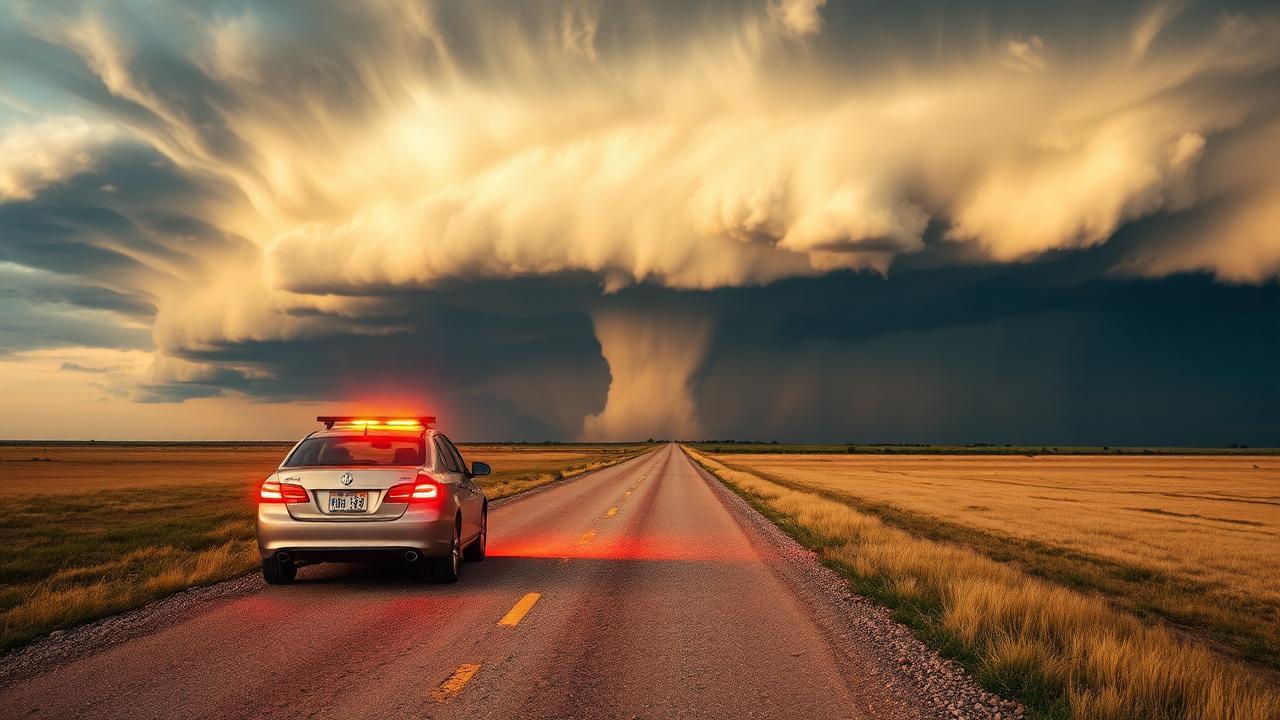
Safety is the only thing that lets you keep chasing
You can be the best forecaster on the plains, but if you take a single bad position next to a rain-wrapped meso, your career ends in a single afternoon. Storm chasing safety isn't a separate skill from chasing — it's the foundation that makes chasing repeatable.
This is a practical, field-oriented guide to the safety practices serious chasers actually use. It is not a substitute for in-person training, hands-on experience, or local NWS spotter classes — go take those.
The single most important rule: south of the meso
For 90% of plains supercells, you want to be south or southeast of the mesocyclone, not in front of it (east) and never north of it.
Why:
- Most supercells move northeast at 25–45 mph
- The hook and tornado are usually on the southwest side of the storm
- The rear-flank downdraft (RFD) and forward-flank precipitation core are north/northeast
- Sitting south puts you with a clear view of the meso and clear escape options to the south and east
Sitting east of a fast-moving supercell is how chasers get hit. Sitting north puts you in the precipitation core and blind. Sitting south keeps the storm visible and your retreat options open.
Build the escape route before you need it
Before you ever pull up to a storm, you should know:
- Which paved east-west road you'll use to stay south of the meso
- Which parallel north-south road you'll use to retreat
- Where the nearest fuel is and whether you have enough to get there
- Where the nearest sturdy shelter is if conditions become survival-mode
This is the answer to one of the eight core chaser questions: "What is my escape route?" You should never be answering it for the first time at the moment you need to use it.
HP supercells are the silent killer
The most dangerous supercell mode for chasers is the HP (heavy precipitation) supercell. HP storms wrap rain around the mesocyclone, hiding tornadoes from view until you're nearly in them. Many of the close calls and deaths in modern chasing involve HP modes.
Signs you're dealing with an HP:
- Effective bulk shear above 55–60 kt
- Visible rain wrapping around the meso on radar
- A poorly-defined hook with the couplet embedded in heavy precip
- Loss of visual on the wall cloud as the storm matures
When the mode is HP, double your safety margin. Stay further south. Watch radar more aggressively. If you lose visual on the meso, retreat south or east immediately — do not drive toward the precipitation to "see what's in there."
Driving in chase conditions
- Slow down in rain. Hydroplaning is a leading cause of chase-related accidents.
- Headlights and hazards in heavy precip — visibility for others matters.
- Never park on a roadway to watch a storm. Get fully off the shoulder. Better: find a side road.
- Watch for chaser convergence. On Enhanced+ days, 30 cars can pile up at one intersection. Plan unconventional positions.
- Don't follow other chasers blindly. They may be wrong, or they may be after a different shot than you.
Hail safety
Large hail is the most common chase injury hazard, not tornadoes. A 2-inch hailstone falling at terminal velocity can break windshields, dent steel, and concuss anyone outside the vehicle.
- Treat any storm with a 60+ dBZ core as a giant-hail risk.
- Never stop to film hail-core cores from inside the forward flank.
- If you must drive through hail, angle the windshield away from the wind direction and slow down.
- Have a hail tarp or blanket in the vehicle for emergency windshield damage.
Lightning
Cloud-to-ground lightning is constant under and around supercells. The leading edge of the forward flank and the immediate vicinity of the storm tower are the highest-risk zones.
- Stay in the vehicle during active lightning.
- If you must be out for photography, stay close to the vehicle and watch the sky.
- If you can count fewer than five seconds between flash and thunder, lightning is striking within a mile.
Tornado-on-you procedure
If you make a mistake and a tornado is bearing down on you with no clean escape:
- Do not try to outrun it perpendicular to its motion if it's already close — drive at 90° to the tornado's path at the highest safe speed.
- If you cannot drive away, abandon the vehicle and lie flat in the lowest ground depression you can find — a ditch or culvert.
- Cover your head. Most tornado injuries come from flying debris, not the wind itself.
- Never shelter under a highway overpass — wind speeds increase there due to the venturi effect.
Health and endurance
- Chase days are 12–16 hours. Sleep before the chase, not after.
- Hydrate constantly. Severe weather days are usually hot.
- Eat real food. Gas-station diet is a tactical mistake.
- Drive with a partner when possible, especially on long chases.
What to keep in the vehicle
- Full tank of gas at the start of the chase
- Phone + tablet, both charged, with cables
- Paper road atlas (DeLorme or similar)
- First aid kit
- Flashlight, rain gear, hail blanket
- Snacks, water (a gallon minimum)
- A way to communicate offline (ham radio if licensed, satellite messenger optional)
Sources
How Meso supports safe positioning
Meso treats "What is my escape route?" and "Should I bail right now?" as first-class questions in its eight-question framework — not afterthoughts. The app continuously evaluates your position relative to the storm's projected path, the road network, daylight remaining, and changing radar signatures, and surfaces clear guidance when the picture shifts. Meso never replaces your visual or your judgment, but it makes sure the data you need to make a safe decision is one glance away instead of three taps deep on three different apps.
Safety is what makes chasing sustainable. Meso is built so the decision aid never gets in the way of it.