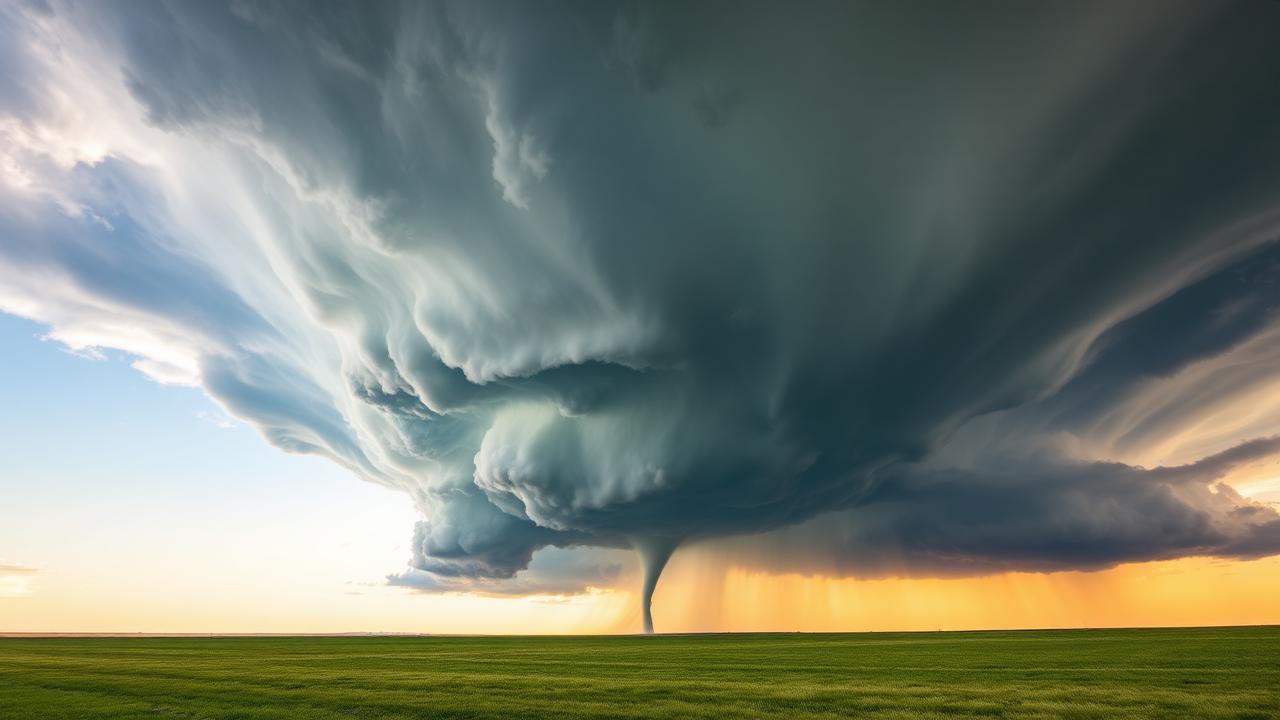
STP — the composite parameter chasers actually trust
STP (Significant Tornado Parameter) is a composite index developed by SPC research meteorologists to combine the key ingredients of significant (EF2+) tornado environments into a single number. It exists because chasers and forecasters were tired of juggling four or five separate fields on every chase day — CAPE, SRH, shear, LCL height — and wanted something that captured the interaction of those ingredients.
STP isn't magic. It's a multiplication of normalized inputs. But because the inputs are well-chosen, STP correlates very strongly with significant tornado occurrence on the plains.
The formula (you don't have to memorize it)
The "effective layer" STP combines:
- MLCAPE normalized against 1500 J/kg
- Effective bulk shear normalized against 20 m/s
- 0–1 km SRH normalized against 150 m²/s²
- MLCIN modifier (penalizes capped environments)
- MLLCL height modifier (penalizes high LCLs that suppress tornado mode)
When all five ingredients are favorable, STP climbs above 1.0. When most are favorable but one is marginal, STP drops back toward 0.
Rough buckets
| STP | What it tells you |
|---|---|
| 0–1 | Marginal at best; non-tornadic storms more likely |
| 1–3 | Favorable; tornadoes possible, including some significant |
| 3–5 | Strong; significant tornadoes likely |
| 5+ | Very high-end; outbreak-level environment |
A peak STP of 3 or higher on SPC mesoanalysis, overlapping the hatched tornado area on the Day 1 outlook, is a textbook chase-day setup.
Why STP works
Tornadoes don't form because one parameter is high. They form because all the parameters are favorable at the same time and at the same place. STP captures that intersection because it's a product — if any input is near zero, the whole composite is near zero.
This is why STP is more useful than CAPE alone or shear alone:
- 5000 J/kg CAPE + 10 kt shear → STP near 0
- 800 J/kg CAPE + 80 kt shear → STP low (CAPE too marginal)
- 1500 J/kg CAPE + 45 kt shear + 200 m²/s² SRH + low LCL → STP > 2
The geographic angle
STP is plotted on a map and animated through the day on the SPC mesoanalysis page. The pattern matters as much as the magnitude:
- A STP bullseye on a boundary (warm front, outflow boundary, triple point) is the most dangerous overlap.
- A broad area of moderate STP suggests scattered tornado threat but no specific bullseye.
- STP increasing rapidly through the afternoon is a sign the environment is sharpening — usually because shear or low-level helicity is ramping up.
Limitations — what STP can't tell you
- STP says nothing about initiation. A 4 STP environment with strong capping and no forcing produces zero tornadoes.
- STP can be model-overdone. Like all composite parameters, STP inherits the errors of its inputs.
- STP is mostly calibrated for the plains. Performance in the southeast US can differ.
- STP isn't designed for cold-season setups. Low-CAPE/high-shear Gulf Coast events often produce tornadoes at STP values that look unimpressive.
How chasers use STP
- Open the SPC mesoanalysis STP page at midday.
- Look for the bullseye — where is STP maximized?
- Cross-reference with the Day 1 outlook hatching — they should agree.
- Check whether the bullseye is on a boundary (warm front, outflow, dryline–WF intersection).
- Pick a target on or just east of the bullseye, where initiation is likely.
Common mistakes
- Chasing the highest STP value blindly. A 6 STP value over an area with no storms is useless.
- Ignoring how STP evolves. A 1 STP at 17Z that climbs to 4 STP at 22Z is a much different day than a flat 3 all afternoon.
- Treating STP as a probability. It's a composite index, not a probability.
How Meso uses STP
STP is one of the headline ingredients Meso uses behind "Is this storm going to produce?" and "Where should I go today?" — two of the eight core chaser questions. Meso pulls effective-layer STP from SPC mesoanalysis and the latest HRRR, watches for bullseye evolution near boundaries, and flags significant changes under "Did anything important just change?" so a sharpening environment doesn't catch you 90 miles from where the action sets up.